Traska Freediver:
the clasp Seiko still won't build.
Seven generations in, Traska's direct-to-buyer diver still undercuts the watch it keeps getting compared to by four hundred dollars and beats it on the one part nobody photographs: the clasp.
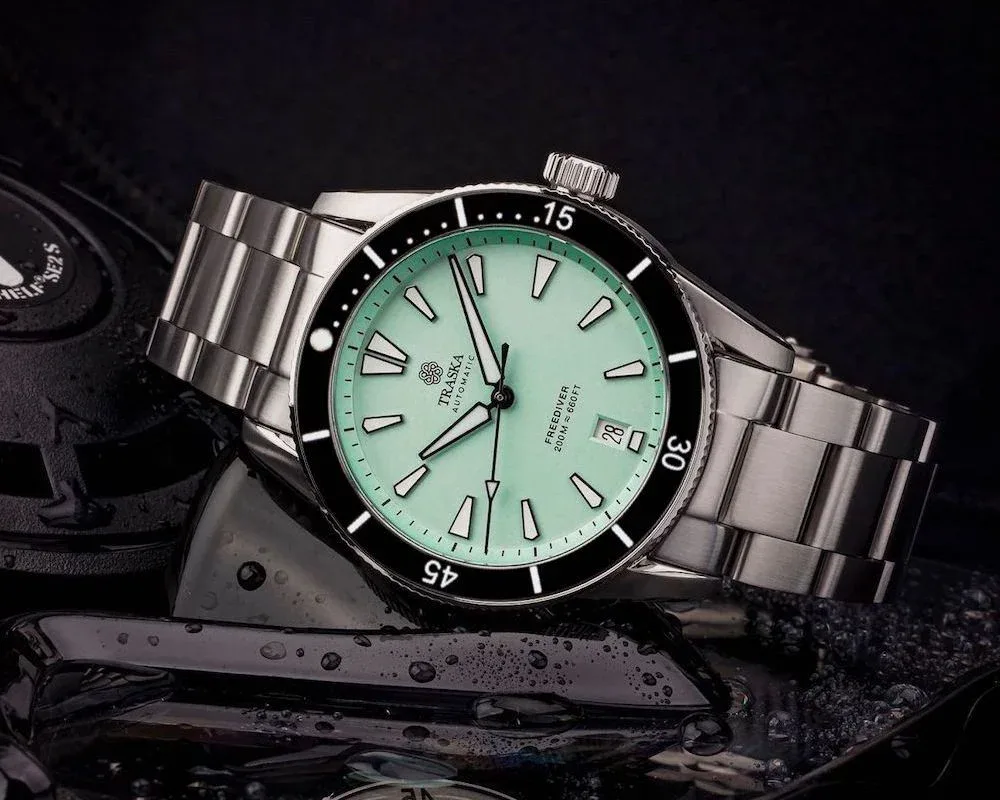
Traska sells the Freediver for $685 to $735 direct from its own store, no dealer markup, and gives you a six-position micro-adjust clasp that Seiko will not put on a watch costing four hundred dollars more. That single component is most of this review, because it is the rare case where the cheaper watch is not compromising on the part that actually touches your wrist every day.
The case for it is the clasp, mostly
The Freediver you can buy today is Ref. 1187, the seventh generation of an idea Traska has been narrowing since it launched the brand in 2018: a 1960s dive-watch silhouette, built without the corner-cutting a company answering to a distributor network might feel pressure to make. The case runs 40.5mm across and 48mm lug to lug, with a box-style double-domed sapphire crystal sitting over a 10.5mm case for a total thickness of 11.9mm. That dome barely taxes the wearing height, which is the whole point of choosing box sapphire over a flat crystal in the first place: you get the vintage silhouette without the vintage thinness underneath it.
Inside, Traska offers a choice most brands at this price do not bother extending: a Miyota 9015 for the version with a date window, a 9039 for the version without, both hacking, hand-winding, and beating at 28,800 vph for a 42-hour reserve. Water resistance is rated to 200 meters, and the ceramic bezel insert turns through 120 clicks unidirectionally, carrying Grade A BGW9 lume that Traska says runs 52 percent brighter after ten hours in the dark than the lume it replaced. The 316L case itself gets a proprietary hardening treatment Traska rates at almost 1200 HV, a real number most microbrands at this price do not publish at all, let alone chase. None of that is unusual for the category on its own. Plenty of microbrand divers clear 200m and run a Miyota automatic.
What is unusual is the bracelet. Traska builds it from 316L steel, tapering from 20mm at the lugs to 16mm at the clasp, with solid end links and quick-release spring bars so you can swap it for a strap without tools. The clasp itself is tool-less and offers six micro-adjust positions. Sit with that number for a second next to the Seiko Prospex SPB143, the watch this one gets compared to constantly in the same breath: checked against Exquisite Timepieces today, the SPB143 still lists at $1,200, the top of its $1,100-1,200 range, when a dealer has stock at all, and its fold-over clasp has no micro-adjust position, on a watch that costs nearly double what the Freediver’s expensive colorway costs. I think that comparison is the entire argument for this watch in one sentence, and Traska did not need a bigger movement or a fancier dial to win it. It needed an engineer who cares about wrist swell over the course of a day, and it has one.
Drilled lugs round out the practical case. Swapping a strap does not require a case-back tool or a spring-bar tool with a magnifying glass, and on a watch this size that matters more than it sounds like it should, because a 20mm lug width tapering to 16mm is a common enough spec that you will actually own straps that fit it.
Where the discount actually cuts
Here is the honest accounting, because a watch this good for the money still has a ceiling, and it is worth naming rather than skating past. The 42-hour reserve is the Miyota 9015/9039 platform’s number, not a boutique in-house figure, and it will not survive a long weekend off the wrist the way the SPB143’s 6R35 and its 70-hour reserve will. Pick the Freediver up on a Tuesday after a weekend on a nightstand and there is a real chance you are resetting the time rather than just the date. That is a genuine cost of choosing the cheaper movement platform, and it is not a small one if your two-day-a-week rotation happens to land this watch on the bench most often.
The bigger cost is reputation rather than parts. Traska sells direct, with no authorized dealer network and none of the decade of secondhand pricing history that a Seiko or a Citizen has built up. That matters twice: once at resale, where a Freediver competes against nothing with an established secondary market, and once at trust, where a buyer who has never heard of the brand has no dealer relationship or showroom visit to lean on before paying full price sight unseen. Traska’s own three-year warranty covers the mechanical risk. It does nothing for the resale math.
Then there is the colorway pricing itself, which Traska does not fully explain. Four of the five current dial options, including the Carbon Black checked for this review, run $735. Mint Green alone sells for $685, a fifty-dollar gap the product pages do not account for. It is not large enough to change a buying decision, but a review that claims to have checked the numbers should say when the numbers do not add up cleanly, rather than rounding the discrepancy away.
Set the Freediver next to the closest thing it has to a direct rival in its own tier and the picture gets more interesting rather than less. Lorier’s current Neptune runs a Miyota 9039 under a domed sapphire crystal with a seven-layer AR coating, priced at $699 as of today. That is close enough to the Freediver’s own $685-735 band that the decision between them comes down to case shape and bracelet spec rather than a meaningful gap in what either one costs you. Lorier leans further into the vintage silhouette; Traska leans into the clasp. Neither answer is wrong, and I would not talk anyone out of either one on value grounds alone, because on value grounds they are close to tied.
So, worth the hype?
Yes, and not by a small margin once you put the number that actually matters next to it. The SPB143 is the watch people default to recommending in this exact case-size and water-resistance bracket, and checked today it costs $1,200 where a dealer has stock left to sell at all, with a clasp that has not had a micro-adjust position added to it in the entire run. The Freediver costs $465 to $515 less, ships a clasp with six adjustment positions instead of zero, and gives up forty percent of the power reserve and all of the resale confidence that comes with a name Seiko has spent sixty years building. That is a trade I would make without hesitating, and I do not think it is a close call.
The Citizen Promaster NY0086 sits underneath both of them, currently discounted to $160.67 against a $325 MSRP, and clears the same ISO-rated 200m bar for a fraction of the outlay. What it does not give you is a box sapphire crystal, a bracelet that tapers to 16mm, or a clasp with any adjustment at all in Citizen’s own published specification. The Freediver is not competing with the Citizen for the same buyer. It is competing with the Seiko, and on the numbers checked today, it wins that fight on price and on the one component a diver’s bracelet actually needs to get right.
Buy the Freediver if a considered clasp and a direct-sale discount matter more to you than a dealer network and a resale market that already exists. Buy the SPB143 instead only if the Seiko name on the dial is doing work for you that the spec sheet alone cannot, because the spec sheet alone no longer makes that case at this price gap.
Is the Traska Freediver worth the money?
Yes, on the numbers checked against Traska’s own store today. At $685 to $735 it delivers a 200m-rated 316L case, a box sapphire crystal, and a six-position micro-adjust clasp that costlier rivals in the same water-resistance class do not match.
How does the Traska Freediver compare to the Seiko Prospex SPB143?
The Freediver undercuts the SPB143 by roughly $465 to $515 at current pricing and adds a six-position micro-adjust clasp the SPB143’s fold-over clasp does not have. The SPB143 answers back with a 70-hour reserve against the Freediver’s 42 and the finishing pedigree of a brand with six decades of dive-watch history behind it.
Does the Traska Freediver have a micro-adjust clasp?
Yes, a tool-less clasp with six adjustment positions, confirmed on Traska’s own product pages. It is the single spec that most separates this watch from pricier rivals in its class.
What movement does the Traska Freediver use?
A Miyota 9015 in the date version or a 9039 in the no-date version, both automatic, hacking, hand-winding, and running at 28,800 bph for a 42-hour power reserve, per Traska’s published specification.
Is Traska a reputable watch brand?
Traska has sold direct to buyers since 2018 and is now on its seventh Freediver generation, backed by a three-year transferable warranty. It has no authorized dealer network and no long secondary market track record, which is the real cost of the discount rather than a knock on build quality.
Computed from the published formula. See the maths →
MIYOTA 9015/9039 · 42H RESERVE
200M WR · BOX SAPPHIRE
316L BRACELET · 6-POSITION MICRO-ADJUST
Retail partners are not live yet. When they are, these become affiliate links. Commissions never touch the score.
- Traska: Freediver Carbon Black product page · Fetched directly today (2026-09-25). Confirms the $735 price, Miyota 9039/9015 movement options, 28,800 bph, 42-hour reserve, 200m (20 ATM) water resistance, sapphire crystal with AR coating, a 120-click unidirectional bezel, a 316L case hardened to almost 1200 HV, the six-position micro-adjust clasp, and the three-year transferable warranty. The movement, power reserve, water resistance, crystal, and clasp figures match the Atlas entry's specification block; the bezel click count and case hardness are additional detail not listed there.
- Traska: Freediver Mint Green product page · Fetched directly today (2026-09-25). Confirms the $685 sale price for the Mint Green colorway, verifying the Atlas priceBand of $685-735 still holds against the maker's own store rather than a third-party listing.
- Traska: Reference Points, the Freediver · Generation history, the current Ref. 1187 designation, the Grade A BGW9 lume update (52% brighter than its predecessor), quick-release spring bars, and the brand's 2018 founding, as published by Traska.
- Seiko: Prospex catalogue (US) · Fetched directly today. The SPB143 no longer appears among current Prospex divers, confirming the reference has left Seiko's standard US lineup, used in the value comparison section.
- Exquisite Timepieces, Seiko Prospex SPB143 listing · Fetched directly today (2026-09-25). Lists the SPB143 at $1,200, out of stock, with a Seiko 6R35 movement, 70-hour power reserve and a fold-over safety clasp with no micro-adjust position, all used in the value comparison section.
- Citizen Watch official EU store, NY0086-16LC · Confirms the 42mm case and 200m ISO-rated water resistance used in the budget comparison, per Citizen's own published specification.
- NYWatchStore, Citizen Promaster NY0086-16L listing · Fetched directly today (2026-09-25). Lists a $325 MSRP against a $160.67 current price, used in the value comparison section.
- Lorier: current Neptune product page · Fetched directly today (2026-09-25). Confirms the 2026 Neptune's $699 price, Miyota 9039 no-date movement and domed sapphire crystal with internal AR coating, used in the microbrand comparison section.
Second opinions.
CREATOR VIDEOS · EMBEDDED WITH FULL CREDITCreator videos appear here as YouTube embeds so every view lands on the creator's own channel. We never re-host or re-cut another reviewer's footage.