Travel is the occasion that punishes a watch for being precious. Bags get dropped, cabins get cold, time zones change under you, and a watch you love gets worn for ten days in conditions it was never designed for. So this is not a list of the nicest watches we have covered. It is a list of the ones whose spec sheets suggest they will cause you the fewest problems away from home, ranked on that single question.
That framing excludes a lot. The Rolex Submariner, the Tudor Black Bay 58 and the Omega Speedmaster Professional are all in our inventory, and all three are serious watches with strong hypescores. None of them is here, because the question is what you should put on your wrist when the bag might be set down in the wrong place. A watch that costs $4,975 to $14,500 asks for a level of care that travel does not give it. We would rather print a short list we believe in than a long one that includes a watch only because it is famous.
Three picks, then, and a planned expansion to six. The expansion is a promise about the method rather than the count. We add a watch only when its entry in our atlas supports a clear reason for it to be on the road.
What travel actually asks of a watch
Strip the occasion down and it asks for four things.
The first is that the watch tells you the time without fuss. On a trip you are tired, you are standing in a queue, and you are not going to unscrew a crown to set a date. A watch that sets itself or carries a second time zone moves that chore from you to the watch. This is the single biggest factor in the ranking.
The second is power you do not think about. A mechanical watch that stops if you leave it on a hotel desk for three days is not a travel problem in itself, but it does mean one more thing to correct. A solar quartz movement that runs for months from a full charge, or a quartz module with a battery rated for years, removes the question entirely.
The third is size. A thick watch catches on a sleeve, presses on a wrist in a cramped seat and sits badly under a jacket. The numbers that matter are thickness and lug to lug, because case diameter alone hides them. Two of our picks publish both. One publishes thickness only in a form we flag as unverified.
The fourth is how much it hurts to lose. This is not a spec, but it is the honest tie-breaker, and the price band sits right on the card for that reason.
Reading the spec sheet for travel
A few lines on the sheet matter more on the road than they do at a desk.
Movement type. For travel, the movement description tells you what you will have to do. A quartz module with solar charging asks for nothing. A quartz module with a battery asks for something in years. An automatic with a GMT complication asks you to set a hand but gives you something no non-GMT watch can: a second time zone, shown at once. An automatic without it is a fine watch and a poor travel companion by comparison, which is why none appear here.
Radio sync. The Casio listing names Multi-Band 6, which Casio describes as radio time sync. We can say the watch carries it, and that Casio publishes it as part of the specification. We cannot tell you where it will reach, and we are not going to guess. If you are going somewhere specific, check Casio’s own coverage information before you rely on it. The feature is a reason to look at the watch, not a guarantee about any country.
Water resistance. We print the rating and leave it there. The ratings in this guide are 200m, 30m and, for the GMT, a conflict between two sources. A number on a case back is what the manufacturer published, and this guide does not add swimming or showering advice to it. If you plan to wear a watch in the water on holiday, read the rating on the card and decide for yourself.
Thickness and lug to lug. Travel makes a watch work harder in a small space. A 13mm case and a 48.8mm lug to lug, as on the Seestern, is a large footprint. An 8.5mm case and a 38.2mm lug to lug, as on the F-91W, is a small one. The Casio GW-M5610U is an integrated resin case and band, so Casio does not publish a lug to lug figure.
Crystal and case material. Sapphire resists scratches better than mineral, and the Seestern has it. The G-Shock has a mineral crystal and a resin case, which is the right trade for a watch meant to be knocked around. The F-91W is resin and acrylic-class material, and Casio does not clearly publish the exact crystal term in our verified source set, so we leave it unlabelled.
Price. The cheaper a watch, the less its loss matters. That is not a cynical observation. It is the reason a $20 watch is a legitimate recommendation on a list about travel.
Why the G-Shock ranks first
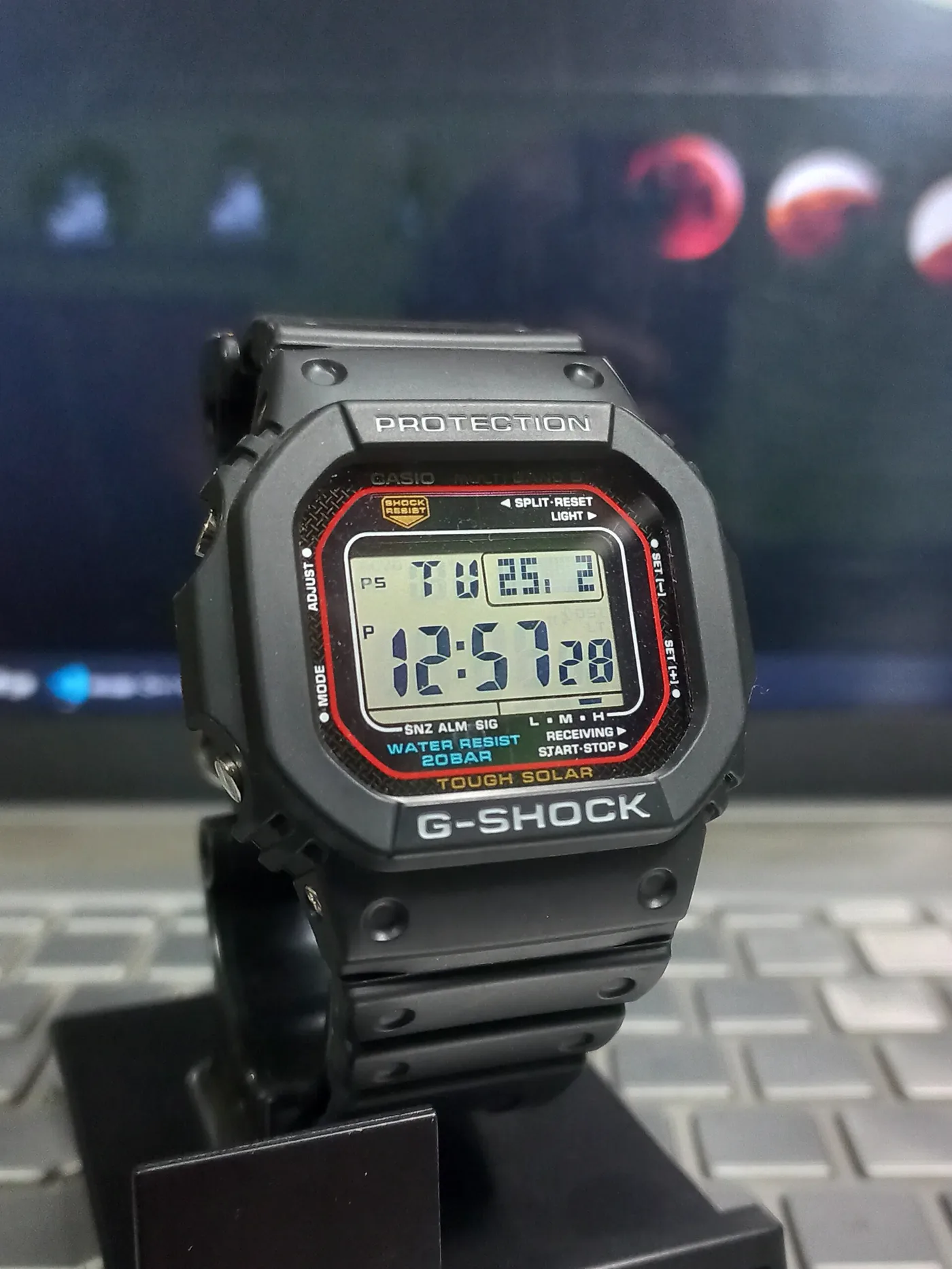
The Casio G-Shock GW-M5610U takes first place because its spec sheet answers the most travel questions at once. The movement is Tough Solar quartz, so there is no battery to replace in the way the F-91W requires. It carries Multi-Band 6 radio time sync, so the time can be set from a signal rather than by hand. The water resistance is 200m. The case and band are one piece of resin. The street price is $100-150, and the hypescore is 88, the highest of the three by a clear margin and tied for the top of the whole inventory.
That hypescore is built from sub-scores: movement 21, build 24, value 25 and wearability 18. The wearability score is the weakest and it is the honest warning on this pick. It is a 43.2mm digital resin watch and it goes with a limited range of clothes. If you only travel in casual clothes, that costs you nothing. If you are travelling for a wedding or a meeting, you may want something else in the bag. Whatever you choose, we would not talk you out of leaving it in the room safe at dinner.
There is also a gap we want to be plain about. Casio’s published thickness and charge-life figures are not machine-verified in our source set. The site refuses automated requests, so the citation points to the brand’s G-Shock site. We say the watch runs for months from a full charge because that is what the listing says. We do not give a number, because we cannot verify one.
Why the GMT is second, and why it is not first
If the guide ranked on features alone, the Seestern S456 GMT might lead, because it is the only watch here that shows two time zones at once. It uses the Seiko NH34, an automatic GMT movement with date at 3 Hz and 24 jewels, and the power reserve is listed as over 40 hours. It has a sapphire crystal, a rotating sapphire bezel insert and a 316L steel bracelet. At $240-280 it is a long way below the price of a traditional GMT.
It is second because of what the sheet cannot settle. The two manufacturer-side pages disagree about water resistance: one says 200m, the other says 100m. We report both and pick neither, and a watch whose rating is unresolved is not our idea of a safe pick for the occasion where it is most likely to get wet. It is also big, at 13mm thick and 48.8mm lug to lug, which matters for the reasons above. Finally, both listings read sold out when we checked, so availability is a risk of its own. The hypescore is 76, with sub-scores of 18 for movement, 18 for build, 21 for value and 19 for wearability.
None of that cancels the central point. If you want home time on your wrist while you are abroad, this is the watch in our atlas that does it. Buy it for that reason and understand the water question first.
Why the F-91W is on a travel list at all
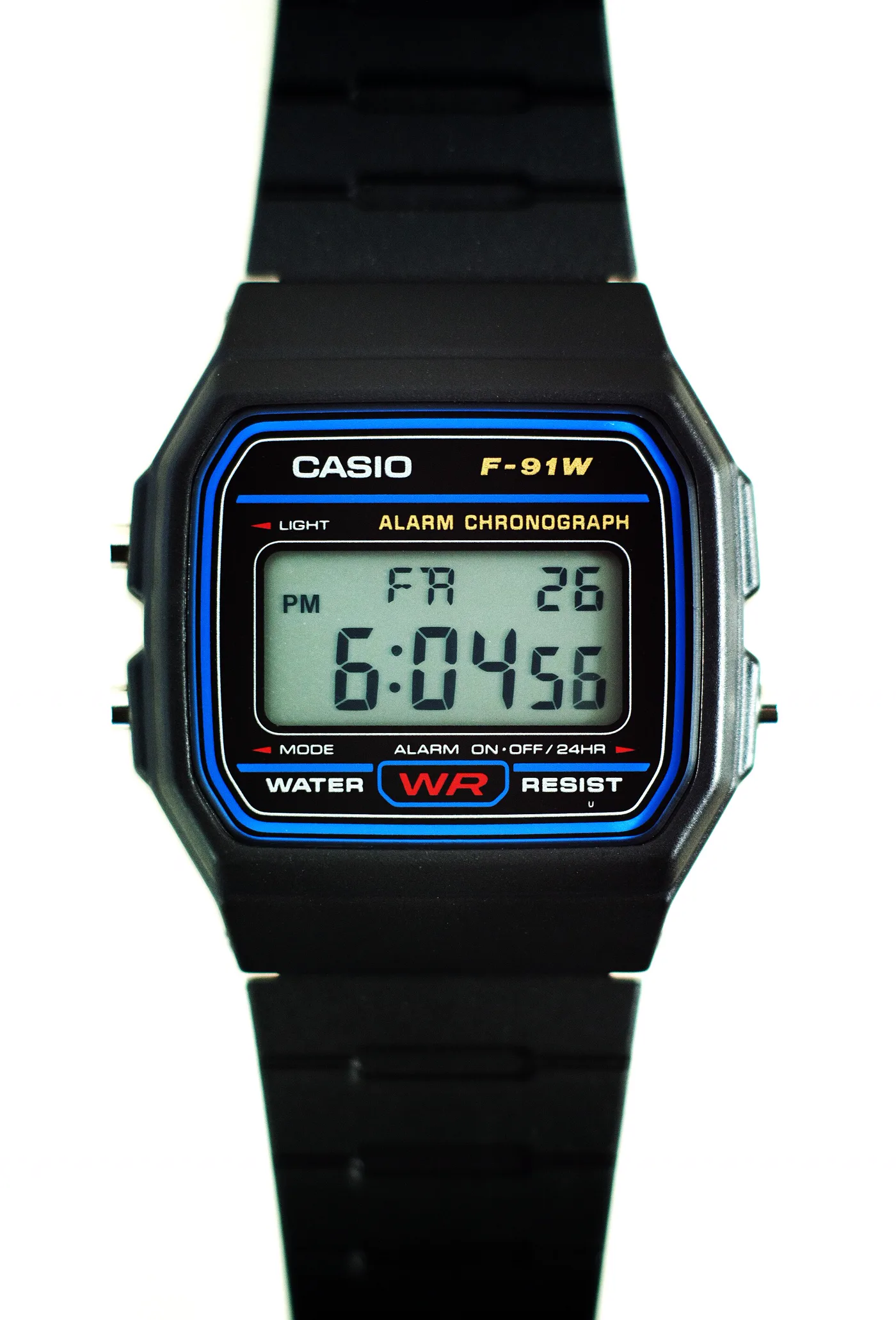
Nobody will be surprised that the Casio F-91W costs between $18 and $25. What is easy to miss is how much it covers. A daily alarm, an hourly time signal, a 1/100-second stopwatch and an auto-calendar all come with Module 593. The battery is a CR2016 rated by Casio for about seven years. The case is 35.2mm wide, 8.5mm thick and 38.2mm lug to lug, which is the smallest footprint in this guide by some distance.
Its hypescore is 67, the lowest here, and the sub-scores show why: movement 15, build 12, value 17 and wearability 23. Wearability is the highest score on its card, which is exactly why it travels well. Build is the lowest, and that is the honest cost. Thirty metres is a modest rating, and the resin construction is what you would expect at that price.
The F-91W belongs in a guide like this as the control. It sets the baseline for a watch that tells you the time, wakes you up and costs almost nothing. Everything else on the list has to justify why it deserves more space in your bag than a twenty-dollar watch does. For the G-Shock the answer is solar power and radio sync. For the Seestern the answer is a second time zone.
What we left out, and why
We left out the dress watches. The Tissot Gentleman, the Junghans max bill and the Cartier Tank Must are good, but they are built for dressing up rather than for a long trip. The Junghans is rated at 5 bar and, per Junghans, is not rated for swimming. The Cartier is rated at 3 bar. Those are fine facts for a wedding and poor ones for a beach.
We left out the divers. Several are good watches, and plenty are well priced, but a high water-resistance rating is not the same thing as a travel feature. Most of them are thick, and many are 13mm or more. A watch that is excellent underwater and heavy on the wrist for the rest of the day is a trade many travellers will not want.
We left out the chronographs, including the Seagull 1963, the Bulova Lunar Pilot and the Omega. A chronograph measures elapsed time, and elapsed time is not what a traveller needs. A second time zone is.
We also left out the watches with a hand-wound or short-reserve design where the reserve is a stated limit rather than a feature. A watch that must be wound or worn daily to keep time is a charming thing at home. On a trip with a tired traveller and a missed day, it becomes a chore.
Finally, we left out anything we could not source. If the inventory does not tell us a number, we do not print one. That is why you will see the phrase “not machine-verified” next to the G-Shock and a conflict flagged on the Seestern. The alternative is to quietly pick the more flattering figure, and that is how buying guides lose trust.
How to choose between the three
If you want the least possible fuss, buy the G-Shock. It is the only pick that combines solar power, radio time sync and 200m of water resistance, and it carries the best score here.
If you genuinely want a second time zone and you are comfortable with a large automatic, buy the Seestern, after you have read the water resistance note on its card and decided whether the unresolved rating matters to you. Be ready to find it sold out.
If you want to take the smallest, lightest, least valuable watch on the trip and keep a better one at home, buy the F-91W. Spend the difference on something else. For a lot of people that is the correct answer, and a guide that was embarrassed by it would not be telling you the truth.
One more practical point. Whatever you choose, think about where the watch will be when you are not wearing it. A watch you take off at security, in a gym or at a pool is a watch you can leave behind. The cheaper the watch, the less that costs you.
What this guide does not claim
We do not claim that any of these will survive any particular treatment. We have the printed specifications, the price bands and the hypescores, and we have used only those. We do not give accuracy figures, because for most of these watches our verified source set does not publish a usable one. We do not call any pick the best in its class, except where the hypescore supports a plain ranking.
The guide is a short list on purpose. It grows to six when there are three more watches we can cite line by line, and it stays at three until then.