Tudor Black Bay 58 review:
the same price buys a stricter watch.
The 2025 Black Bay 58 is 0.2mm thinner, tested by an outside lab on top of Tudor's own COSC rating, and finished with a clasp that finally adjusts without a toolkit. Checked today, the price for all of that has not moved a dollar.
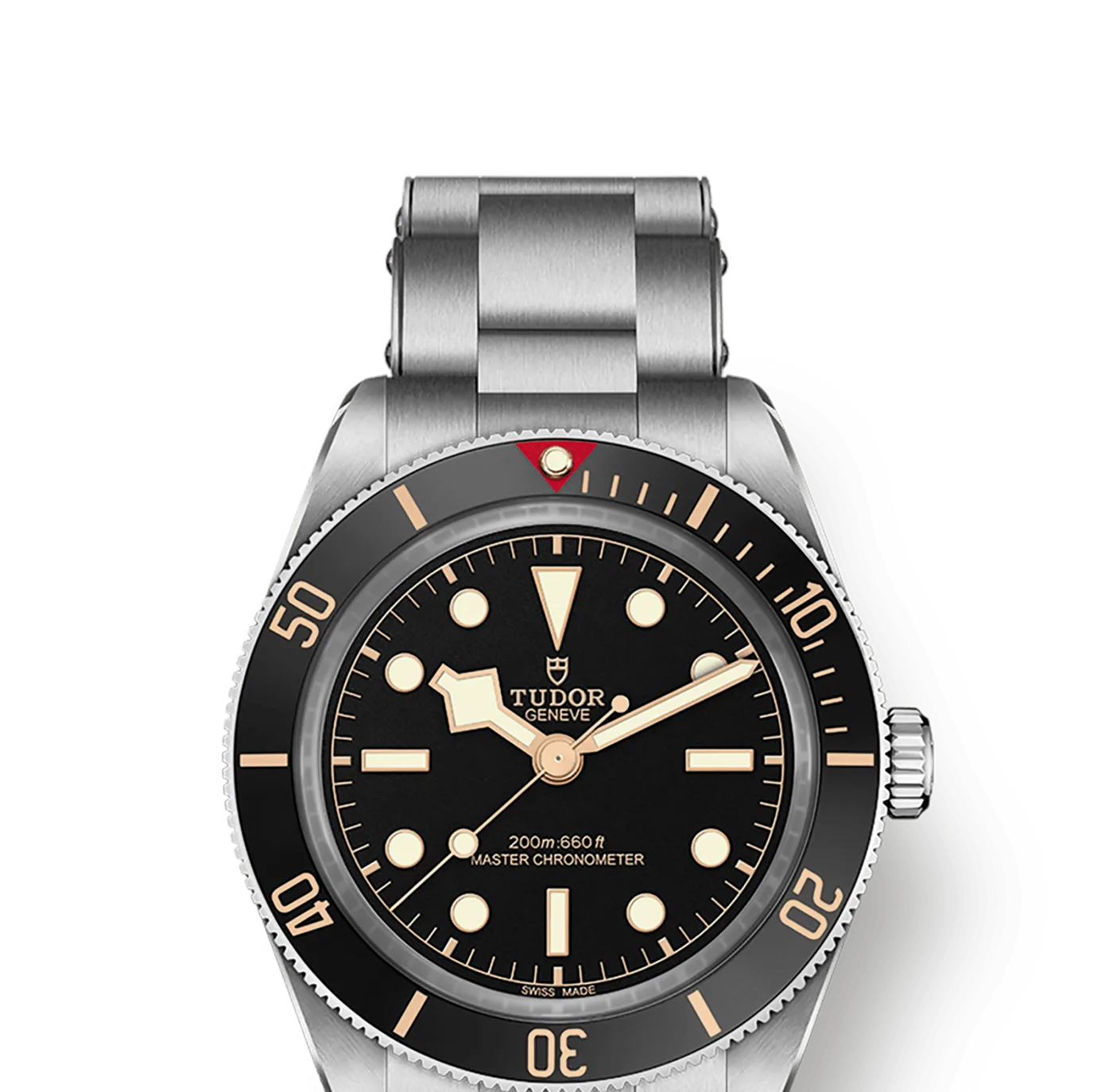
Read a Tudor Black Bay 58 review written before 2025 and you are reading about a watch this one replaced. The case dropped from 11.9mm to 11.7mm, the movement gained a METAS Master Chronometer certification stacked on top of Tudor’s own COSC rating, and the bracelet finally got a clasp that adjusts without a spring bar tool. Checked against an authorized dealer’s listings today, the three-link version, reference M7939A1A0NU-0002, still rings up at $5,225, the exact figure this Atlas recorded three days ago. Nothing about the price moved. Almost everything about the watch did.
The case for it starts with what changed in 2025
The numbers Tudor lists for this reference are 39mm across, 11.7mm thick and 47.8mm lug to lug, on a 20mm lug width sized for the same straps and bracelets the line has used since 2018. Monochrome’s hands-on with this exact reference confirms all three case figures directly, and the thickness is the one that matters. Down from 11.9mm on the outgoing case, it is a small number that reads larger on the wrist than the two tenths of a millimetre suggests, because it is the difference between a case that clears a shirt cuff cleanly and one that catches on it. The crystal is domed sapphire with an anti-reflective coating, and water resistance is rated to 200 meters.
Inside is the MT5400-U, a manufacture movement built with Kenissi, running at 28,800vph across 27 jewels, with a silicon balance spring, a variable inertia balance and a stop-seconds function for setting the time to the second. Tudor rates the reserve at 65 hours minimum, a METAS-specified floor rather than an optimistic ceiling, and that distinction matters more than the number itself. METAS testing checks the movement across six positions, two temperatures and two power-reserve states before it earns the Master Chronometer label, the same outside-lab standard Omega uses, and a materially harder bar than Tudor’s own COSC certification carries alone. Part of that testing is resistance to 15,000 gauss of magnetism; Tudor and Monochrome do not publish the specific accuracy tolerance or any water-resistance safety margin for this reference, so neither figure appears here. That is independently confirmed government-lab testing, not a number a marketing department typed into a press release, and it is the actual news of the 2025 refresh far more than the thinner case is.
The clasp finally listens to its own reviews
The bracelet on this reference is a three-link, rivet-style design in steel, and Tudor also sells the same case on a five-link jubilee-style bracelet for $5,350 or a black rubber strap for $4,975. Whichever you pick, the clasp is new: a T-fit design with a tool-free 8mm micro-adjustment window and ceramic ball bearings so the mechanism does not gall over years of daily use. That closes the single complaint this Atlas keeps raising about clasps at a fifth the price, and it is a genuine upgrade over the outgoing generation’s fixed links.
It is not, however, as generous as the clasp Rolex reserves for its professional dive watches. Rolex’s Glidelock extension, fitted to the Sea-Dweller and Deepsea rather than the Submariner, is a longer and more complex design than the Submariner’s own Oysterlock clasp, and it adds up to 20 millimetres of length in 2mm increments, well over double the Tudor’s adjustment range. If your wrist swells noticeably across a hot afternoon or a long flight, a Sea-Dweller or Deepsea accommodates more of that swing than the Black Bay 58 does. That is a real limitation next to Rolex’s own dive-watch clasp engineering, not a rounding error, and I would not pretend otherwise just because the rest of the bracelet finishing is this good.
The price held, and the certification is why
Checked against an authorized dealer’s listings today, the pricing across all three configurations of this reference matches the Atlas exactly: $4,975 for the rubber strap, $5,225 for the three-link bracelet, $5,350 for the five-link. A second buying guide, fetched the same day, lists the identical three figures. Tudor’s own site would not confirm this directly. It returned HTTP 403 to every path tried today, exactly as it did when the Atlas entry was filed, so the two authorized-dealer sources above are doing the verification Tudor’s own domain will not.
There is no waiting list drama attached to any of those numbers, which is worth naming because the watch this one is constantly measured against has one. The Black Bay 58 does not trade above retail the way Submariners do, and the only documented resale data available is for the previous-generation 79030N, which trades 35 to 40 percent below its original price. Nobody has published current-generation resale figures yet, since this exact reference has been on shelves less than a year, and I am not going to guess at a number nobody has measured. What that leaves you with is a straightforward transaction: walk into a boutique or an authorized dealer, pay the number printed above, and walk out. No allocation, no relationship with a sales associate required, no premium.
That straightforwardness is also the honest reason the value sub-score sits at 17 out of 25, the lowest of this watch’s four pillars and the one I would not round up for anybody. Seiko’s Prospex SPB143 runs $1,100 to $1,200, comes in at 13.2mm thick across a 47.6mm lug-to-lug case, and banks 70 hours off its own 6R35 automatic, a movement that will not clear the Black Bay’s word count on a spec sheet but will tell the same time within a few seconds a week for roughly a fifth of the outlay. Christopher Ward’s The Twelve, at $1,150 to $1,395, runs 9.95mm thick on a Sellita SW200-1 at the same 28,800vph beat rate, with an integrated bracelet and a toolless three-position micro-adjust clasp of its own, for roughly a quarter of what the Tudor asks, if what you actually want is finishing and a movement you can set your watch by rather than a dive case specifically. Neither of those watches carries an independent METAS certification. Both of them do the job of telling time and looking considered doing it, for a fraction of the money.
What it is not
It is not a scarce watch, and it should not be shopped like one. Unlike the steel sports watches it gets cross-shopped against most often, an authorized dealer with this reference in stock will generally sell it to a first-time customer at the price printed above, the same day, with no history required.
It is not the thinnest case in its own genre either. 11.7mm is a real improvement over 11.9mm, and it wears the difference, but it is not a transformation. This is still a proper 200-meter tool watch with the heft that rating implies, not a dress watch wearing a dive bezel for effect.
It is not appreciating, and Tudor is not selling it as though it will. The resale pattern documented for the outgoing generation runs well below retail rather than above it, and nothing in the current sourcing suggests this generation breaks that pattern. Buy it to wear it. Do not buy it as a hedge.
It is not, finally, the watch to buy if the clasp is the actual deciding factor for you. An 8mm adjustment window is a real upgrade over no adjustment at all, but it is a fraction of what Rolex’s Glidelock-equipped Sea-Dweller and Deepsea offer at a higher price, and Christopher Ward’s toolless three-position system on The Twelve covers more practical range for far less money, on a different kind of watch entirely.
So, worth the hype?
Yes, and the reasoning is arithmetic rather than sentiment. For the same $5,225 this line charged before the 2025 refresh, you now get a case measurably thinner than its predecessor, a movement independently tested by an outside lab rather than merely self-certified, and a clasp that finally adjusts without a toolkit. That is three real upgrades for zero additional dollars, verified today against two authorized-dealer sources rather than assumed from last year’s price sheet.
The catch is the one this review has already named twice: $5,225 is real money, the value sub-score is the lowest of this watch’s four pillars, and a Seiko or a Christopher Ward will do most of the practical job for a fraction of the outlay. If the METAS certification and the manufacture movement are not something you would ever personally verify, buy the Seiko and bank the difference. But if you want a Swiss dive watch you can walk in and buy today, with no waiting list and a bracelet that finally fits properly out of the box, this is still the one to default to. It has been for eight years, and the 2025 refresh is the first time in that stretch Tudor has actually made the case better rather than just repeating the pitch.
Is the Tudor Black Bay 58 worth the money in 2026?
At $5,225 for the three-link bracelet, checked today against two authorized-dealer sources, yes. The 2025 refresh adds a thinner case, an independently METAS-certified movement and a tool-free adjustable clasp for the same price the previous generation charged, which is a genuine improvement rather than a repackaging.
What is the difference between the three-link and five-link Black Bay 58?
The case and movement are identical either way. The three-link, rivet-style bracelet reviewed here runs $5,225. The five-link, jubilee-style option runs $5,350, and a black rubber strap runs $4,975. The choice is purely about which bracelet style and price you prefer.
How does the Tudor Black Bay 58 compare to the Rolex Submariner?
The Submariner runs a stricter in-house chronometer standard, and it holds resale value the Black Bay 58 does not, but it also costs roughly double Tudor’s retail price and carries a waiting list at most dealers. The Black Bay 58 is the watch you can walk in and buy today for about half the money and most of the certification story.
Is the online reputation of the Black Bay 58 accurate?
The recurring debate among owners and prospective buyers, wherever the discussion happens, settles on the same two questions every time: three-link or five-link, and whether the gap to a Seiko SPB143 is worth paying for a movement most owners will never personally send to a lab. Neither question has a universal answer, and the watch’s reputation as the default recommendation once a Seiko stops feeling like enough holds up against its own spec sheet rather than against hype alone.
Does the Tudor Black Bay 58 hold its value?
Not the way a steel Rolex does. The only documented resale data available covers the previous-generation 79030N, which trades 35 to 40 percent below its original retail price, and the Black Bay line generally does not trade above retail the way Submariners do. Buy this watch to wear it rather than to bank it.
Computed from the published formula. See the maths →
MT5400-U · COSC/METAS · 65H MIN
200M WR · DOMED SAPPHIRE
THREE-LINK BRACELET · T-FIT CLASP
Retail partners are not live yet. When they are, these become affiliate links. Commissions never touch the score.
- Tudor official site · Checked again today: Tudor's own domain returns HTTP 403 to automated fetches on the root and on the product path alike, the same result the Atlas entry for this watch recorded. Case dimensions, movement and certification figures below are instead corroborated against Monochrome's hands-on coverage of this exact reference.
- Monochrome Watches: hands-on, Black Bay 58 Black-Gilt (M7939A1A0NU) · Fetched directly today. Confirms the 39mm by 11.7mm by 47.8mm case, the MT5400-U movement running at 28,800vph across 27 jewels with a silicon balance spring and stop-seconds function, the METAS testing regime of six positions, two temperatures and two power-reserve states, resistance to 15,000 gauss, the T-fit clasp's 8mm micro-adjustment window with ceramic ball bearings, and per-configuration CHF and EUR pricing across the rubber, three-link and five-link options.
- The 1916 Company: Tudor Black Bay 58 listings · Fetched directly today for a live US price check. Confirms authorized-dealer retail pricing of $4,975 for the rubber-strap M7939A1A0NU-0003, $5,225 for the three-link M7939A1A0NU-0002 reviewed here, and $5,350 for the five-link M7939A1A0NU-0001, matching the Atlas priceBand exactly.
- The Watchology: Tudor Black Bay 58 buying guide (2026) · Fetched directly today. Corroborates the same retail price table by configuration and states that the Black Bay 58 does not trade above retail the way Submariners do. Documented resale data exists only for the previous-generation 79030N, at 35 to 40 percent below its original retail price; no secondary-market figures exist yet for the current METAS-certified generation, and none are invented here.
- Bob's Watches: Rolex clasps reference guide · Fetched directly today. Confirms the Glidelock extension system, fitted to the Rolex Sea-Dweller and Deepsea and distinct from the Submariner's own Oysterlock clasp, adds up to 20 millimetres of bracelet length in 2mm increments, used here for comparison against the Black Bay 58's own T-fit adjustment window.
- Seiko: Prospex catalogue · The direct SPB143 product URL returned a 404 at fetch time today, so the reachable Prospex catalogue root is cited instead, confirmed live. Comparison figures for the SPB143 (case size, thickness, lug to lug, power reserve, price) match the WatchHypeHQ Atlas entry for that watch, which sources them to Seiko's own published specification.
- Christopher Ward official site · Comparison figures for The Twelve, used in the value section, matching the WatchHypeHQ Atlas entry for that watch. The direct product URL was not machine-verifiable at fetch time, so the manufacturer domain is cited instead.
Second opinions.
CREATOR VIDEOS · EMBEDDED WITH FULL CREDITCreator videos appear here as YouTube embeds so every view lands on the creator's own channel. We never re-host or re-cut another reviewer's footage.